
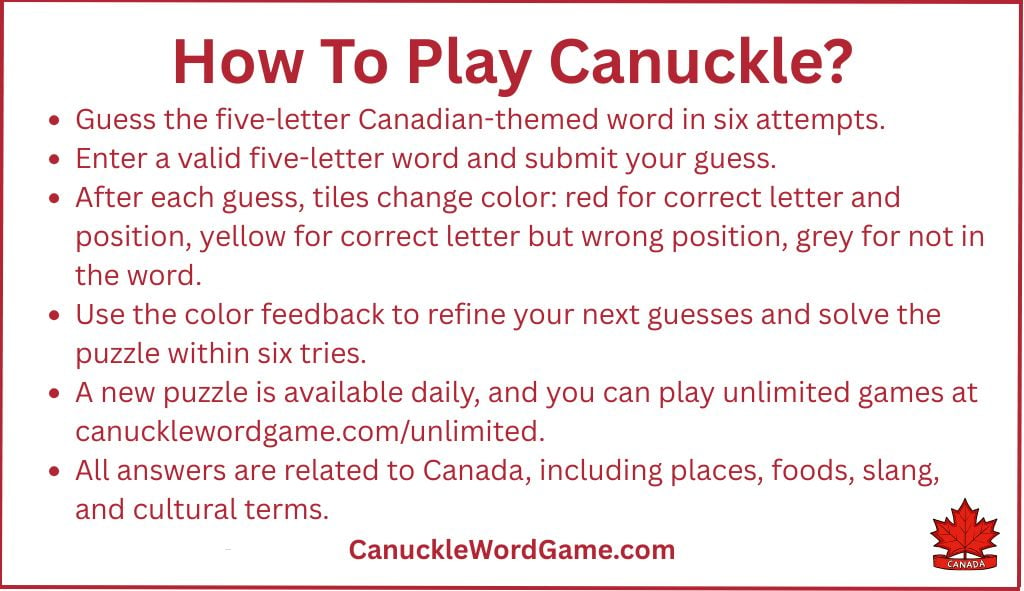
To play Canuckle, guess a hidden five-letter Canadian word in six tries. Type any valid five-letter word and press enter. The tiles change colour to show how close you are. Red means the letter is correct and in the right spot. Yellow means the letter is in the word but misplaced.
Grey means the letter is not in the answer at all. Every answer has a Canadian connection. Past words include moose, maple, and toque.
That is the whole game in one paragraph. The sections below cover the colour system and valid guesses. They also show how to build a solving routine. New players usually solve their first puzzle within four or five guesses. Regular players often finish in three.
What Canuckle Is and Where It Came From
Canuckle is a daily word puzzle built on the Wordle format. Ottawa brothers Mark and Jeff Rogers launched it on February 10, 2022. Mark works for the federal government at Shared Services Canada. Jeff has a background in mobile and web development. The canuckle meaning blends “Canuck,” a nickname for Canadians, with “Wordle.”
The timing mattered. The New York Times bought Wordle on January 31, 2022. The price was in the low seven figures. Wordle had 90 players on November 1, 2021. By early January it had more than 300,000.
Millions were playing daily by the time of the sale. The Rogers brothers wanted a free, homegrown alternative. It had to celebrate Canada.
The first run lasted 142 puzzles. It ended on Canada Day, July 1, 2022. The brothers then rebuilt the platform from scratch. The game relaunched later that year on new code.
By April 2026, the game had passed 240 million plays. FACES Magazine reported over 12 million unique players. The City of Ottawa proclaimed February 7, 2025 as Canuckle’s 1000th Puzzle Day.
The Rules of Canuckle Explained
The rules fit on an index card. You have six rows on the board. Each row holds one five-letter guess. You must submit a real word from the game’s dictionary. Random letter strings are rejected before they reach the board.
What the Tile Colours Mean
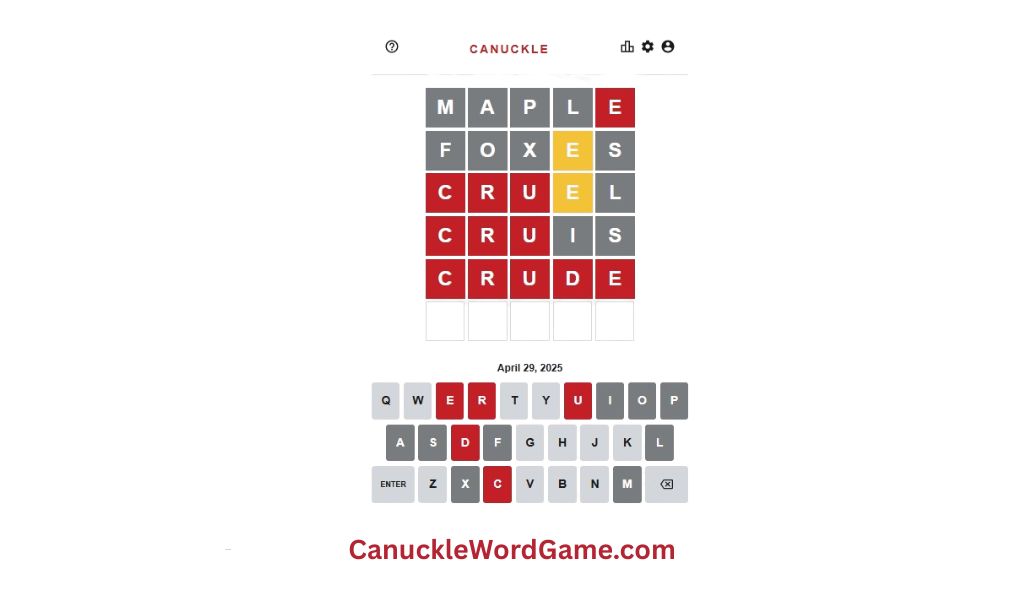
After each guess, every tile turns one of three colours. These colours are the only feedback you get. Reading them correctly is the core skill of the game.
- Red tile: the letter is in the answer and in that exact position.
- Yellow tile: the letter is in the answer but belongs somewhere else.
- Grey tile: the letter does not appear in the answer at all.
Canuckle uses red instead of Wordle’s green. The change is a nod to the Canadian flag. Everything else about the feedback works the same way. The keyboard beneath the board also updates with each guess. Grey keys tell you which letters to avoid.
How Repeated Letters Are Scored
Repeated letters trip up many beginners. Suppose the answer is GEESE and you guess EAGLE. The first E turns yellow because E belongs elsewhere. The final E turns red because it sits in the right spot. The game only colours as many copies as the answer contains.
Now suppose your guess has two Es and the answer has one. Only one E gets coloured. The other turns grey. This rule tells you the exact count of that letter.
Pay attention to it. It often removes several candidate words at once.
What Counts as a Valid Guess
Any real five-letter English word works as a guess. Your guess does not need to be Canadian. Only the answer has a Canadian link. Proper nouns are sometimes allowed because Canadian place names appear as answers. Words like BANFF or YUKON have shown up in past puzzles.
Plurals ending in S are generally accepted as guesses. They rarely appear as answers. Keep that in mind when choosing your final guess. Slang and regional words sit in the dictionary too. ABOOT once caused an uproar among players, as Mark Rogers told CBC.
How to Play Canuckle Step by Step
Here is the full routine, from opening the page to sharing. Follow it once and it becomes second nature.
- Open the game in any browser on phone, tablet, or desktop.
- Type a five-letter starting word using the on-screen or physical keyboard.
- Press enter and read the tile colours carefully.
- Keep red letters fixed in place for your next guess.
- Move yellow letters to a different position.
- Drop every grey letter from your remaining guesses.
- Repeat until all five tiles turn red or you run out of rows.
- Read the fun fact that appears after the puzzle ends.
- Share your results grid with friends using the share button.
The share grid uses coloured squares with no letters. Friends can see how you did without learning the answer. This spoiler-free format helped Wordle spread across social media in December 2021. Canuckle inherited the same viral loop.
Choosing a Strong First Word
Your opening guess sets up the entire puzzle. A good first word tests common letters in common positions. A weak first word wastes a row. The difference often decides whether you finish in three or five.
Letter Frequency in Five-Letter Words
Data from Wordle answers gives a useful baseline. One analysis covered every answer through July 2023. It found E appeared 376 times. A appeared 339 times and R appeared 302 times.
T, O, L, and I each appeared more than 200 times. J and Q were the rarest, at fewer than ten appearances each.
The same analysis found S was the most common starting letter. It opened 103 answers. C, A, B, and T followed. For the second position, O led with 108 appearances.
A, R, L, and E filled out the top five second letters. Canuckle’s word list differs, but the English patterns still apply.
First Words That Suit Canuckle
Canuckle answers lean on Canadian vocabulary. Words about weather, wildlife, geography, hockey, and food appear often. Vowel-heavy openers still work well. Strong choices include:
- ARISE or RAISE: tests A, E, R, S, and I in one go.
- SLATE or STARE: covers S at the front and E at the end.
- MOOSE: Canadian themed, tests O twice and the common S and E.
- CANOE: tests three vowels and the frequent C and N.
- ROUTE: tests three vowels plus R and T.
Pick one opener and stick with it for a few weeks. Consistency teaches you how the feedback usually unfolds. You will notice patterns faster than a player who changes openers daily.
The Two-Word Opening
Some players use a fixed pair of opening words. The first word tests five letters. The second tests five completely different letters. Together they cover ten of the most common letters in two guesses.
A common pair is RAISE followed by CLOUT. Another is STARE followed by DOING. After two guesses you know a great deal about the answer. The trade-off is that you rarely solve on guess two. Players who chase three-guess solves usually prefer this method.
Reading the Feedback Like an Experienced Player
Beginners see colours. Experienced players see constraints. Every coloured tile removes hundreds of words from the pool. Learning to think this way is the biggest jump in skill.
Fix the Reds First
A red tile locks that letter in place permanently. Every remaining guess should keep it there. Moving a confirmed red letter throws away certain information. There is never a reason to do it.
Two reds usually narrow the field to a few dozen words. Three reds often leave fewer than ten. At that stage, think about Canadian words that fit the pattern. The theme becomes your strongest clue.
Rotate the Yellows
A yellow tile tells you two things. The letter is present. That position is wrong. Try the letter in a fresh position on your next guess. Never place it in a slot where it has already turned yellow.
Track which positions each yellow letter has occupied. A letter yellow in slots one and three has three homes left. It must sit in two, four, or five. After two yellows, the letter often has only one possible home left.
Eliminate the Greys Completely
Grey letters are gone for the rest of the puzzle. Using one again wastes a guess. The on-screen keyboard greys them out to help you. Glance at it before every guess.
Some players deliberately reuse grey letters. This lets them test new letters elsewhere in the word. This is a valid tactic on guess three or four. It only makes sense when several candidates remain. The sacrificial guess splits them apart.
Using the Canadian Theme to Your Advantage
The Canadian link is not decoration. It is the single biggest clue in every puzzle. A Wordle answer could be any of roughly 2,300 words. A Canuckle answer must connect to Canada. That shrinks the pool sharply.
Common Answer Categories
Past answers cluster into a handful of themes. Knowing them helps you guess smarter after two rows of feedback.
- Wildlife: MOOSE, GOOSE, BEARS, LOONS, WHALE, TROUT.
- Geography: BANFF, YUKON, ROCKY, LAKES, COAST, NORTH.
- Weather and seasons: SNOWY, FROST, SLEET, CHILL, STORM.
- Food and drink: MAPLE, SYRUP, BACON, TARTS, TIMMY.
- Sport: SKATE, PUCKS, RINKS, STICK, CURLS.
- Culture and slang: TOQUE, HOSER, ABOOT, SORRY.
- History and government: CROWN, QUEEN, PARTY, VOTES.
Every word above is five letters and fair game. Keep a mental list of Canadian five-letter words. It grows with every puzzle you play.
The Fun Fact Feedback Loop
Every solved puzzle reveals a short fact about the answer. The fact explains the Canadian connection. Read it each day. Over time these facts build a vocabulary of Canadian terms.
Many are words you had not considered. Yesterday’s fun fact often becomes next month’s answer pattern.
Daily Puzzle, Streaks, and Timing
Canuckle releases one puzzle per day. Everyone in the world gets the same word. Your streak counts consecutive days solved. Miss a day and the streak resets to zero.
The puzzle changes at midnight in your local time zone. Players in Vancouver and Halifax see new puzzles four hours apart. Travelling across time zones can shift when the new word appears. This mirrors how Wordle handles its daily reset.
Statistics appear after each game. They track games played, win percentage, current streak, and maximum streak. A distribution chart shows how many guesses you usually need. Most regular players settle around an average of four guesses.
What to Do When You Are Stuck
Sometimes the fourth guess reveals nothing new. This happens most with answers that share four letters with many words. Think of SHARE, SCARE, SNARE, SPARE, and STARE. Guessing them one by one can burn every remaining row.
Two options help here. The first is a sacrificial guess. It tests all the differing letters at once. CHAMP tests C, H, M, and P in one row.
The second option is a daily canuckle hint. It narrows the theme without spoiling the word.
If the last row fails, the answer appears on screen. The canuckle answer today is published each morning with its fun fact. Many players prefer to solve first and verify second.
Playing More Than One Puzzle a Day
The daily format limits you to one word. That is by design. It keeps the game fresh and the community aligned. Some players want more practice, especially while learning.
Practice mode solves this. Canuckle unlimited serves a new Canadian word every time you finish one. It is the fastest way to learn the answer categories. Ten practice rounds teach more than a month of single daily puzzles. Beginners should play a few unlimited rounds before committing to a streak.
Players who enjoy logic puzzles have a second daily option. Canoku is a Canadian take on sudoku from the same creators. It uses emoji or themed symbols instead of digits. The two games share a daily reset. Many players pair them each morning.
Common Beginner Mistakes to Avoid
Most early losses come from the same handful of errors. Fixing them lifts your win rate quickly.
- Reusing grey letters. Check the keyboard before every guess.
- Moving red letters. Locked letters stay locked.
- Placing a yellow in the same slot twice. Rotate it every time.
- Guessing obscure words. Canuckle answers are familiar Canadian terms.
- Ignoring double letters. GOOSE, MOOSE, and SLEET all repeat a letter.
- Forgetting the theme. Ask what Canadian word fits the pattern.
- Guessing plurals as answers. They almost never end a puzzle.
One more mistake is rushing. The puzzle has no timer. Take a moment before each guess. Write down the known constraints if it helps. Slow, careful play beats fast, sloppy play every time.
How Canuckle Compares to Wordle
The two games share the same six-guess, five-letter structure. The differences are small but meaningful.
- Colour scheme: Canuckle uses red for correct placement. Wordle uses green.
- Answer pool: Canuckle words connect to Canada. Wordle words are general English.
- Fun facts: Canuckle shows trivia after every game. Wordle does not.
- Ownership: Canuckle is independent. Wordle belongs to The New York Times.
- Spelling: Canuckle accepts Canadian spellings like COLOUR where they fit.
Players who already play Wordle can switch instantly. The muscle memory transfers. The only adjustment is thinking Canadian from the first guess onward. Many people play both games daily. Advice on how to win Wordle every time carries over almost entirely.
A Sample Game Walked Through
Here is how a typical game unfolds. The hidden answer for this example is MAPLE.
Guess one is RAISE. The A turns yellow. The E turns yellow. R, I, and S turn grey. You now know A and E are present but misplaced.
Guess two is CANOE. The A turns red in position two. The E turns red in position five. C, N, and O turn grey. The pattern is now _A__E with A locked and E locked.
Guess three should test new consonants. MAPLE fits the pattern and uses only fresh letters. It is also a strong Canadian word. The tiles turn fully red. The fun fact notes the maple leaf flag dates from 1965.
That solve took three guesses. The key move was using guess two to confirm the vowel positions. Guess three then applied the Canadian theme to a narrow pattern. This is the rhythm to aim for in every puzzle.
Building a Daily Habit
Canuckle takes two to five minutes. Most players fit it into a morning coffee or a commute. Pairing it with an existing routine makes the streak easier to keep.
A few habits help long-term play. Use the same opener each day. Read every fun fact. Play unlimited mode when you want to sharpen a weak spot.
Share the grid with a friend who plays. Friendly competition keeps most people coming back.
Canadians make up most of the player base. The game still works for anyone curious about Canada. Newcomers to the country often use it to learn regional vocabulary. Teachers have used it in classrooms for the same reason. The daily fact turns a quick puzzle into a small lesson.
Frequently Asked Questions
Can I play Canuckle more than once per day?
The daily puzzle is one word only. Unlimited mode offers as many practice rounds as you like. Streaks apply only to the daily puzzle.
Do I need to be Canadian to play?
No. Anyone can play. Knowing Canadian culture is an advantage, not a requirement. The fun facts teach the vocabulary over time.
Is Canuckle free?
Yes. The game has been free since launch in February 2022. It runs in any web browser with no download required.
What happens if I run out of guesses?
The answer is revealed with its fun fact. Your streak resets. The next puzzle arrives at midnight.
Why are the correct tiles red instead of green?
The red colour honours the Canadian flag. It is the only cosmetic change from the Wordle format.
Can the answer be a place name?
Yes. Canadian cities, provinces, territories, and landmarks have appeared. BANFF and YUKON are two examples.
How many people play Canuckle?
By April 2026, 12 million unique players had logged 240 million games. Tens of thousands return every day to keep their streaks alive.