
You can win Wordle every time by combining three habits. Open with a high-value starting word such as SLATE or CRANE. Choose a second word that tests five brand-new letters. Then narrow the answer using letter position data rather than gut feeling. MIT researchers proved this method never fails when followed exactly.
Their algorithm solved every possible puzzle in five guesses or fewer. Its average was just 3.421 guesses per game. You will not match a computer, but you can copy its logic. The tips below explain each step in plain language. Every statistic comes from a named source listed at the end.
Why Wordle Can Be Beaten With Strategy
Wordle is not a vocabulary test. It is a logic puzzle with a fixed answer list. Josh Wardle built the game with 2,309 possible solutions and roughly 12,972 accepted guesses. The New York Times now adds new words from time to time. Still, the answer pool remains small and predictable.
That predictability is your biggest advantage. Every guess should remove as many wrong answers as possible. A good opener can cut thousands of options down to a few dozen. A weak opener leaves you guessing blindly on turn four. Skilled players think about elimination, not inspiration.
The scale of the game shows how many people care about this. Wordle was played 4.2 billion times in 2025, according to The New York Times. That works out to about 11.5 million games every day. The 2024 figure was 5.3 billion plays, and 2023 saw 4.8 billion. Few daily puzzles have ever held an audience that large.
Pick a Starting Word Backed by Data
Your first guess matters more than any other. The New York Times built WordleBot to analyze player games. Its current top opener in normal mode is SLATE. The bot rates it 99 out of 99 for skill.
CRANE, TRACE, CRATE and CARTE earn the same top score. Any of these five gives you a strong foundation.
WordleBot has changed its favourite several times. It used SLATE, then switched to TRACE in January 2024. CRANE took over from February 2024 until July 2025. SLATE returned after further analysis in mid 2025. The differences between these words are tiny in practice.
How tiny? The Times calculated that TRACE beats SLATE by just 0.0006 guesses per game. A daily player would need over four and a half years to gain one guess. So pick one top-tier word and stop worrying. Consistency matters more than chasing the newest ranking.
What MIT Found About the Perfect Opener
Professor Dimitris Bertsimas and researcher Alex Paskov at MIT Sloan solved Wordle exactly. They modelled the game as a Markov Decision Process. Their algorithm tested every possible guess against every possible answer. The mathematically optimal first word turned out to be SALET. A salet is a type of medieval helmet.
SALET reveals an average of 1.683 coloured tiles on the first move. The popular opener AUDIO reveals only 1.320 coloured tiles. SALET also performed about 1 per cent better than SLATE at narrowing options.
The researchers noted a pattern. A, E and T appear in all five of their top words. S, L and R feature in most of them too.
You do not need to memorize obscure helmets. SLATE contains the same letters as SALET in a different order. Both give you two vowels and three of the most common consonants. Either word starts you on the right path.
Why ADIEU Is a Trap
Many players swear by ADIEU because it tests four vowels. WordleBot data shows it is the most common starting word among players. Yet the Times reports ADIEU trails TRACE by about a fifth of a guess. Over one year, that adds up to 74 extra turns.
The problem is simple. Vowels are easy to find later. Consonants shape the structure of a word. Knowing you have an A and an E rarely narrows things much. Knowing you have an S, T and R does far more work.
Understand Wordle Letter Frequency
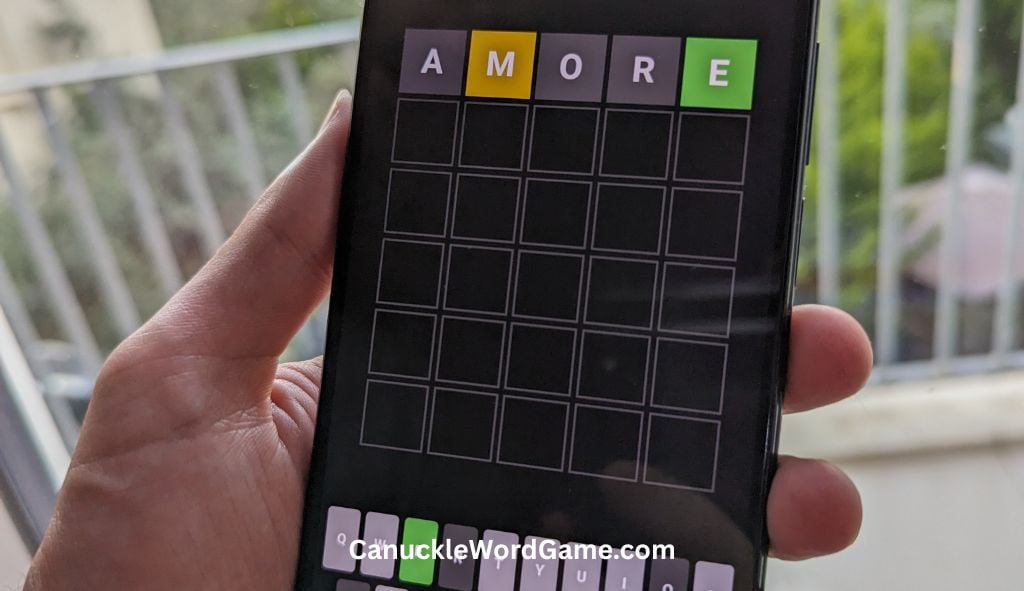
The Wordle answer list does not match English as a whole. Analysis of the full solution list shows the ten most common letters in order. They are E, A, R, O, T, L, I, S, N and C. One frequency study counted E 1,233 times across the 2,315 original target words. A, R, O and T follow close behind.
Some letters are far rarer than you might expect. The letter N appears in nearly 7 per cent of dictionary letters. In Wordle answers it drops to just under 4 per cent. Meanwhile B, Y and G show up more often than general English suggests. Five-letter words simply behave differently from the wider language.
Position matters as much as frequency. S is the most common first letter by a wide margin.
Tom’s Guide reviewed every answer through mid 2023. S opened 103 solutions. C came second with 70, followed by A and B with 57 each. For the second letter, O leads with 108 appearances, ahead of A with 100.
E dominates the final position. It is the most frequent letter in both fourth and fifth place. Endings such as ER, SE and TY appear again and again. Starting pairs like ST, CR, GR and FL appear more than players realize. Keeping these patterns in mind speeds up every solve.
Use a Strong Second Word
Your second guess should almost never reuse letters from the first. If SLATE returns all grey tiles, you have ruled out five letters. Now test five more common ones. Words like CRONY, MOUND, PRICK or BOUND work well here. Together with SLATE, they cover the bulk of the answer pool.
Some players use a fixed two-word opening every day. The pairing of ROAST then CLINE is a well-known example. One Reddit analysis tested this pairing. It produced a third-guess win 46.95 per cent of the time.
The combined ten letters include every vowel. They also cover R, S, T, C, L and N. That leaves very few hidden answers untouched.
There is a trade-off with a fixed second word. If your opener scores several greens, a preset second word wastes information. Skilled players adapt instead. With two or more greens, switch to candidate answers immediately. With zero or one coloured tile, play the second elimination word.
Do Not Ignore Yellow Tiles
A yellow tile tells you two things. The letter is in the answer, and it is not in that position. Beginners often note the first fact and forget the second. Track both.
Suppose R is yellow in position two. R must then sit in slot one, three, four or five.
Write the remaining slots out if it helps. Many top players keep a mental grid of confirmed and banned positions. This habit alone prevents most third-guess mistakes. It also stops you from repeating a yellow letter in the same spot twice.
Think Like WordleBot on Guess Three
By your third guess you should have a short list of candidates. This is where average players lose streaks. They guess the first plausible word that fits. WordleBot does something smarter. It picks the word that splits the remaining candidates most evenly.
Consider the classic trap of a pattern like _IGHT. The MIT researchers used this exact example. FIGHT, LIGHT, MIGHT, NIGHT, RIGHT, SIGHT and TIGHT all fit. Guessing them one by one could take six turns.
Instead, the algorithm played an unusual word like FERMS. That single guess tested F, R, M and S together. It eliminated five options in one move.
You can apply the same logic without any software. When four or more candidates share a pattern, do not guess a candidate. Guess a word that contains the differing letters instead. Sacrificing one turn often saves two. This move separates streak keepers from streak breakers.
Handle Double Letters Carefully
Double letters break more streaks than any other pattern. The hardest Wordle of 2025 was BONGO, which ended 36,337 streaks on May 14. The Times games team blamed the split double O. Words like ALLOW, EERIE, FLUFF and MUMMY cause the same trouble.
Wordle does not tell you when a letter repeats. If you get one yellow O, the answer may still contain two. Remember that answers with repeated letters are less common but far from rare. If your candidate list runs dry, test a double-letter option before panicking. Always keep this possibility in mind after guess four.
Learn From Every Game With WordleBot
WordleBot is free to use through The New York Times Games site. After each puzzle it grades your skill and luck out of 99. It also shows how many candidates remained after each guess. Reviewing this data teaches you faster than any tips article. Most players find their skill score jumps within two weeks.
The bot bases its advice on real games, not theory. Its January 2024 update drew on 515 million Wordle games played over one year. That is why its recommendations shift as player behaviour changes. When the bot updates, its top words are worth a second look.
Pay attention to the “luck” score too. A lucky win in three does not mean you played well. A skilful loss in six can still show good process. Focus on raising your average skill number across a month. Winning every time follows naturally from good process.
Manage Your Streak and Timing
Streaks reset for practical reasons as often as logical ones. Playing on two devices without logging in can wipe your record. So can missing a day by a few minutes.
Understanding exactly when does Wordle reset each day protects your streak from careless losses. The puzzle changes at midnight in your local time zone. There is no single global reset moment.
The New York Times requires an account to track streaks and stats. Without one, clearing your browser cache erases your history. Sign in once on every device you use.
Travelling across time zones can also cause confusion. The game follows your device clock. An early flight may open a new puzzle before you expect it.
Wordle answers can now repeat. Starting on February 2, 2026, the Times began reusing previous solutions. This keeps the game going beyond its original word limit. It also means past answers are no longer safe to rule out. Words like SLATE and CRANE could appear as solutions again.
Practise With Wordle Variants
Practice makes strategy automatic. The official game only allows one puzzle a day. Several variants let you play many rounds and sharpen your elimination skills. Each teaches something slightly different.
Dordle asks you to solve two words at once with seven guesses. Learning how to play Dordle forces you to manage two boards. You must track twice the information.
Quordle raises the challenge to four simultaneous puzzles in nine guesses. Working through how to play Quordle builds the habit of testing many letters early. Both games punish wasted guesses far more harshly than Wordle does.
Canadian players have a homegrown option too. Canuckle is the Canadian Wordle with maple-leaf-themed answers linked to Canada. The same elimination logic applies. The answer pool leans toward Canadian places, food and culture.
Playing Canuckle unlimited lets you run through dozens of puzzles in one sitting. Repetition of the same method across different word pools cements the skill.
A Repeatable Wordle Routine
Here is a routine you can follow every day. It takes about two minutes and works in normal mode.
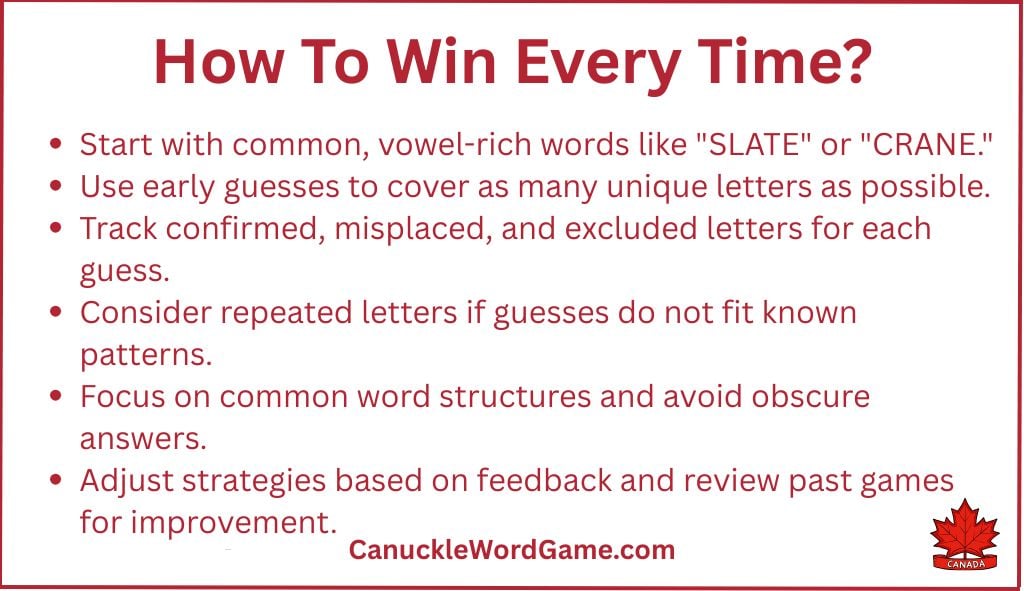
- Open with SLATE, CRANE, TRACE, CRATE or SALET.
- If you score zero or one coloured tile, play a second elimination word such as CRONY or MOUND.
- If you score two or more greens, move straight to candidate answers.
- Track yellow positions. Never repeat a yellow letter in the same slot.
- When four or more candidates share a pattern, play a splitter word instead of guessing.
- Consider double letters if your list runs dry after guess four.
- Check WordleBot after the game and note your skill score.
Follow this list for a month and your average should settle near four guesses. The MIT benchmark of 3.421 is a machine average. Human experts typically land between 3.5 and 3.9. Saint Paul, Minnesota, holds the best American city average at 3.51 guesses. That figure shows how strong disciplined human play can be.
Hard Mode Changes the Best Words
Hard mode forces you to reuse any green or yellow letters in later guesses. This removes the option of a pure elimination second word. WordleBot adjusts its advice accordingly. In hard mode it prefers CLASP, with SCALD and PLACE close behind. Earlier versions favoured LEAST, DEALT and TROPE.
The MIT team also solved hard mode. Their algorithm still wins every possible game, though the average rises slightly. The lesson for hard-mode players is caution with early greens. A green letter in position one narrows your future words drastically. Openers with fewer common first letters can actually help here.
Common Mistakes That End Streaks
Most losses come from a handful of avoidable errors. Recognizing them is half the battle.
- Guessing a plausible word on turn three when five candidates remain.
- Forgetting that a yellow letter cannot sit in the same position again.
- Ruling out double letters too early.
- Reusing grey letters by accident in later guesses.
- Playing without an account and losing stats to a cache clear.
- Opening with a vowel-heavy word like ADIEU or AUDIO.
Fixing even two of these will raise your win rate noticeably. Wordle rewards patience over speed. Nobody is timing you. Take an extra thirty seconds before every guess. Read the board again before you press enter.
Another subtle error is ignoring word structure. Most five-letter answers follow a consonant-vowel-consonant rhythm. If you have two consonants confirmed, expect a vowel between them. Patterns such as CVCCV and CCVCV cover a large share of solutions. Using structure this way trims your candidate list faster than letter counting alone.
Creating Your Own Puzzles Builds Skill
One underrated way to improve is to build puzzles for friends. When you create your own Wordle, you start thinking like the puzzle setter. You notice which letter patterns are hard to crack. You also learn which words have many close neighbours. That perspective feeds back into your solving.
Custom puzzles also help with double-letter awareness. Set a word like GEESE or LLAMA and watch how friends struggle. You will remember the lesson when a repeated letter hides in the daily answer. Teaching a strategy is one of the fastest ways to master it.
Why the Method Works Every Time
Wordle has a finite answer list and six guesses. Every strong opener removes a huge share of that list. Every disciplined follow-up removes most of what remains. By guess four, a careful player almost always has one or two candidates left. That is why the MIT algorithm never needs a sixth turn.
You will not play perfectly every day. But the gap between a lost streak and a hundred-day run is small. It comes down to letter frequency, position awareness and elimination over guessing. Apply those three ideas and losing becomes rare. Apply them for long enough and it becomes almost impossible.
Sources
- The New York Times, “Wordle Games Portfolio Play Figures for 2025”, 2026
- The New York Times Upshot, “WordleBot Has a New Favourite Starting Word”, January 2024
- Forbes, “Wordle Has a New Best Starting Word After Wordle Bot Update”, August 2022
- Forbes, “Wordle Bot Has a New Best Starting Word as Slate Is Wiped Clean”, January 2024
- TechRadar, “Best Wordle Starting Words for a Great First Guess”, February 2026
- TechRadar, “Wordle Has a New Best Start Word”, January 2024
- MIT Sloan Ideas Made to Matter, “How an Algorithm Solves Wordle”, 2022
- Bertsimas, D. and Paskov, A., “An Exact Solution to Wordle”, Operations Research (INFORMS), 2024
- CNBC, “This Is the Best Wordle Starting Word According to MIT Researchers”, September 2022
- Tom’s Guide, “I’ve Analyzed Every Wordle Answer Used, Here’s What I Found”, July 2023
- Tom’s Guide, “I Analyzed Every Wordle Answer to Look for Patterns”, February 2026
- Real Statistics, “Wordle Letter Frequency and Patterns”, 2022
- Axios, “Wordle Vowels and Most Common Letters”, February 2022
- TODAY, “The Hardest Wordle and Connections Games of 2025”, December 2025
- Fast Company, “These Head-Spinning Wordle Statistics Show Why The New York Times Is Turning the Game Into an NBC TV Show”, May 2026
- A Media Operator, “The New York Times Wants the Wordle TV Show to Re-Energize Lapsed Players”, August 2026
- Gulf News, “The New York Times Buys Wordle, the Ultra-Popular Online Word Game”, January 2022
- The Smart Local, “12 Best Starting Words for Wordle”, April 2026